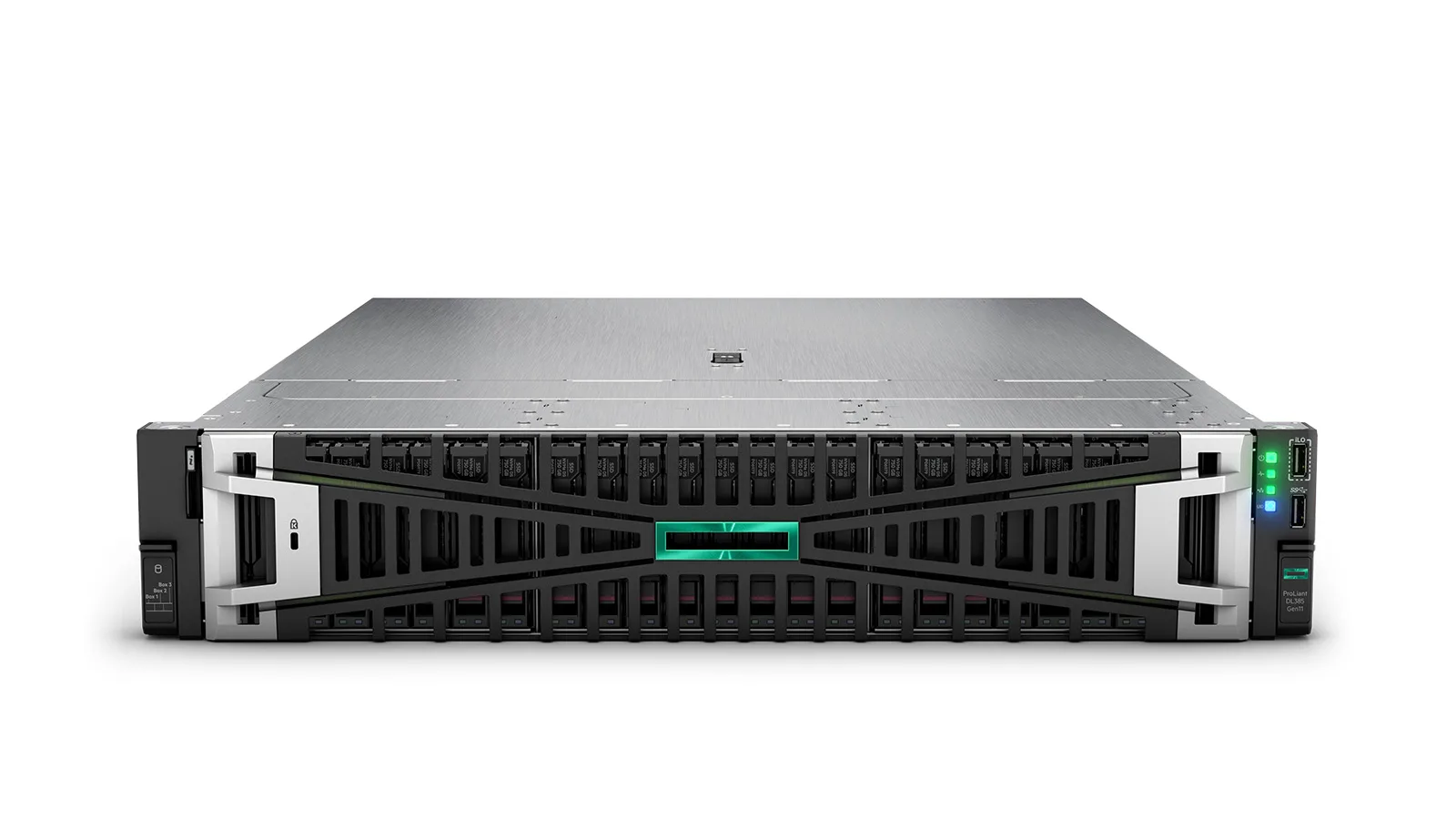
HPE Synergy 480 Gen12
Overview
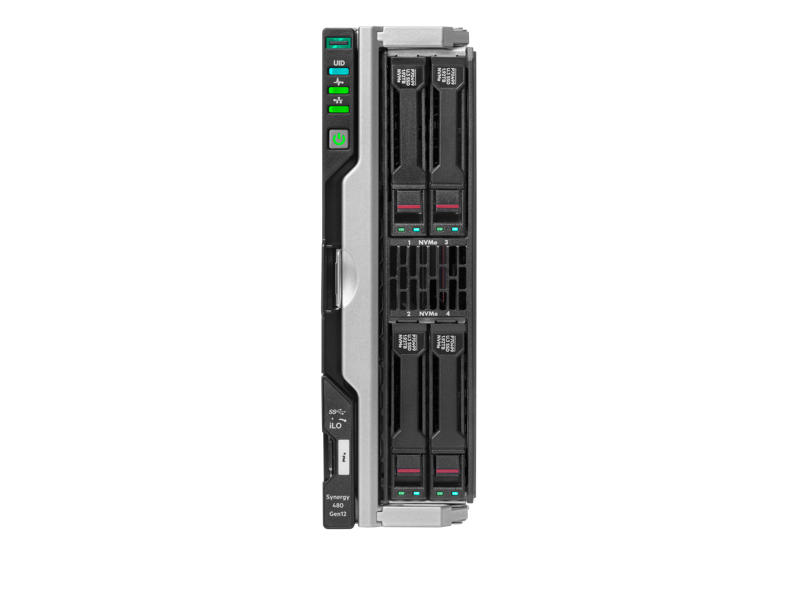
The HPE Synergy 480 Gen12 Compute Module is the latest generation of HPE composable blade infrastructure, engineered exclusively for deployment within the HPE Synergy 12000 Frame and representing a substantial advancement in processor performance, memory capacity, security architecture, and cloud-native manageability over the Gen11 platform. Powered by 5th Gen Intel Xeon Scalable processors (Emerald Rapids), the module supports up to two processors with up to 64 cores each, providing up to 128 total cores per compute module for compute-intensive enterprise virtualization, distributed AI inferencing, real-time financial analytics, and high-frequency transactional database workloads. The platform integrates with HPE OneView 9.x and HPE Synergy Composer 3.0, delivering infrastructure-as-code automation with expanded Redfish 2.1 API coverage, automated compliance baselining, and firmware lifecycle orchestration across multi-frame logical enclosures managed as a unified composable domain. As the most advanced compute module in the HPE Synergy portfolio, the Synergy 480 Gen12 is purpose-built to serve as the foundational compute layer for organizations executing hybrid cloud transformation strategies on HPE GreenLake, delivering consistent policy enforcement, observability, and workload portability across on-premises and cloud-managed infrastructure.
Performance
The HPE Synergy 480 Gen12 is powered by dual 5th Gen Intel Xeon Scalable processors (Emerald Rapids) supporting up to 64 cores and 128 threads per socket, delivering a maximum of 128 cores and 256 threads per compute module with base frequencies up to 3.8 GHz and all-core turbo frequencies sustained through Intel Turbo Boost Max Technology 3.0 and enhanced thermal design. Each processor natively supports Intel Advanced Matrix Extensions (AMX) with expanded BF16 and INT8 tile matrix multiply throughput, Intel In-Memory Analytics Accelerator (IAA), Intel Data Streaming Accelerator (DSA), and Intel QuickAssist Technology (QAT) for hardware-offloaded compression and cryptographic processing, reducing host CPU utilization on data pipeline and security workloads. DDR5 memory operating at 5600 MT/s across a 8-channel per-socket memory subsystem delivers aggregate memory bandwidth exceeding 358 GB/s per socket, enabling in-memory databases, real-time stream processing engines such as Apache Kafka and Apache Flink, and latency-sensitive OLTP workloads to sustain peak throughput without memory subsystem saturation. PCIe 5.0 lane availability of up to 80 lanes per processor ensures that next-generation NVMe Gen5 storage adapters, 400 GbE fabric interconnects, and GPU or FPGA mezzanine accelerators operate without I/O bandwidth constraints, maintaining full line-rate throughput across all expansion slots simultaneously.
Architecture
The HPE Synergy 480 Gen12 is architected on the Intel Xeon Scalable Emerald Rapids platform with the Intel C960 chipset, featuring enhanced UPI 2.0 inter-socket interconnect at up to 20 GT/s for NUMA-optimized dual-socket workloads requiring high-bandwidth cross-socket memory access with minimized latency penalties. The module occupies a single bay within the HPE Synergy 12000 Frame, connecting to the frame midplane for shared redundant power delivery, dedicated out-of-band management signaling via HPE iLO 7, and high-speed composable fabric uplinks to HPE Virtual Connect SE 400Gb interconnect modules without any discrete internal cabling. HPE iLO 7 is implemented as a standalone security and management ASIC embedded on the system board, featuring an Arm Cortex-A72 quad-core management processor, 4 GB dedicated management DRAM, dedicated 1 GbE management network port, and a hardware-isolated execution environment that remains fully operational and tamper-resistant independent of host processor and OS state. The updated dual mezzanine slot architecture supports PCIe 5.0 x16 per slot, accommodating HPE Virtual Connect SE 400Gb F32 Module interconnects, NVMe-oF storage HBAs, InfiniBand HDR100 adapters, and HPE OPA (Omni-Path Architecture) fabric cards for high-performance computing interconnect fabrics within the composable blade form factor.
Memory And Storage
The HPE Synergy 480 Gen12 provides 32 DIMM slots supporting DDR5 RDIMMs and LRDIMMs at speeds up to 5600 MT/s, with a maximum raw memory capacity of 16.0 TB per compute module using 512 GB LRDIMMs, doubling the addressable memory space of the Gen11 platform and enabling single-module deployment of very large in-memory database instances previously requiring multi-node clustered configurations. DDR5 on-DIMM ECC with per-nibble error correction, improved row hammer mitigations, and power management integrated circuits (PMICs) on each DIMM provide enhanced memory reliability, reduced power consumption per gigabyte, and improved RAS (Reliability, Availability, Serviceability) characteristics compared to DDR4 implementations. Internal boot storage is provided via up to two M.2 NVMe Gen5 or SATA SSD slots, with the optional HPE NS406i-u NVMe U.2 Hot Plug Boot Device supporting RAID 1 mirrored boot for high-availability OS configurations without consuming mezzanine slot bandwidth. HPE Smart Array Gen12 controllers deployable via mezzanine slots support SAS 24G, NVMe Gen5, and NVMe-oF (NVMe over Fabrics via RoCE v2 and iWARP) with hardware RAID 0/1/5/6/10/50/60, up to 16 GB FBWC backed by supercapacitor energy storage, and inline hardware-accelerated AES-256-XTS drive encryption without host CPU overhead.
Networking
The HPE Synergy 480 Gen12 supports HPE Virtual Connect SE 400Gb F32 Module for Synergy via its dual PCIe 5.0 mezzanine slots, delivering up to 400 GbE per port for converged LAN, SAN, NVMe-oF, and RDMA traffic over a single unified composable fabric, representing a 4x increase in per-port bandwidth over the Gen10 platform and a 2x increase over Gen11. HPE Virtual Connect SE 400Gb technology supports RDMA over Converged Ethernet v2 (RoCE v2) with hardware-offloaded RDMA send and receive operations, enabling distributed AI training cluster interconnects, parallel file system clients such as Lustre and GPFS, and latency-sensitive financial trading middleware to achieve sub-2-microsecond end-to-end fabric latency. SR-IOV with up to 256 virtual functions per physical port enables fine-grained PCIe 5.0 passthrough to virtual machines and Kubernetes pods, bypassing the hypervisor network stack for workloads requiring bare-metal equivalent network performance within fully virtualized or containerized execution environments. HPE OneView 9.x and Synergy Composer 3.0 manage all fabric configurations through declarative network profile templates, supporting automated VLAN provisioning, DCB (Data Center Bridging) policy enforcement, QoS queue management, and uplink failover configuration applied consistently across all compute modules within a logical enclosure through a single API-driven management plane.
Security Features
The HPE Synergy 480 Gen12 introduces HPE Silicon Root of Trust Generation 3 embedded within the iLO 7 ASIC, providing a cryptographically immutable hardware anchor that validates every firmware component in a strict chain-of-trust sequence from power-on reset through OS handoff, with tamper-evident logging of all firmware validation events to an iLO-resident secure audit log inaccessible to the host OS. HPE Secure Boot with UEFI 3.1 enforces signed bootloader, kernel, and driver module verification with support for customer-managed Secure Boot key databases, enabling organizations to restrict boot to internally signed OS images for air-gapped and high-security deployment scenarios. HPE Runtime Firmware Integrity Monitoring performs continuous cryptographic hash verification of all resident firmware images during system operation using iLO 7 hardware-isolated compute, triggering automated firmware recovery from HPE-signed golden images stored in protected iLO flash without requiring host OS intervention or manual administrator action. TPM 2.0 with FIPS 140-2 Level 2 certification is available as a factory-integrated option, supporting remote attestation via TPM Quote, platform configuration register (PCR) sealing for BitLocker and measured boot workflows, and integration with Microsoft Azure Attestation Service and HashiCorp Vault for cloud-native secrets management pipelines.
Management And Monitoring
The HPE Synergy 480 Gen12 is managed through HPE iLO 7, which introduces a fully redesigned RESTful management API surface aligned to DMTF Redfish 2.1 and SNIA Swordfish 1.2 specifications, providing comprehensive server, storage, network, and power domain management through a single unified API endpoint with OpenAPI 3.0 schema documentation published for all supported operations. HPE OneView 9.x delivers centralized server profile template management, automated SPP (Service Pack for ProLiant) firmware baseline compliance, hardware health aggregation, and event-driven remediation workflows across multi-frame Synergy deployments, with native Terraform provider, Ansible collection, Puppet module, and Chef cookbook support for infrastructure-as-code pipeline integration. HPE Synergy Composer 3.0 provides composable infrastructure orchestration with enhanced logical enclosure management, automatic resource pool rebalancing, and API-first design supporting full lifecycle automation from initial frame discovery through server profile assignment, workload provisioning, and hardware decommissioning without manual console intervention. HPE GreenLake Compute Ops Management delivers SaaS-based firmware lifecycle automation, compliance dashboards, cross-site health monitoring, and consumption analytics across all connected Synergy 480 Gen12 deployments globally, enabling centralized IT operations without requiring on-premises management infrastructure at remote or edge datacenter locations.
Scalability
A fully populated HPE Synergy 12000 Frame housing 12 HPE Synergy 480 Gen12 Compute Modules delivers up to 1,536 processor cores, 192 TB of DDR5 memory, and 4.8 Tbps of composable fabric bandwidth per frame at maximum configuration, establishing the Synergy 480 Gen12 as the highest-density composable blade platform in the HPE portfolio. HPE Synergy Frame Link Modules connect up to four HPE Synergy 12000 Frames into a single logical enclosure managed by a redundant pair of HPE Synergy Composer 3.0 appliances embedded within the primary frame, scaling to 48 compute modules and 6,144 processor cores under unified management without additional external management infrastructure. The composable fabric architecture of the HPE Synergy 12000 Frame allows independent scaling of compute, storage, and network fabric resources, enabling organizations to add HPE D3940 Storage Modules, upgrade fabric interconnects from 200 GbE to 400 GbE, or increase compute density by replacing lower-specification modules with Synergy 480 Gen12 nodes without disrupting adjacent resources or requiring frame downtime. HPE GreenLake as-a-Service consumption models allow organizations to deploy HPE Synergy 480 Gen12 infrastructure with pay-per-use metering based on actual core utilization, memory consumption, and network throughput, eliminating upfront capacity overprovisioning and aligning infrastructure costs directly with business workload demand across quarterly billing cycles.
Use Cases
The HPE Synergy 480 Gen12 is optimally configured for enterprise hypervisor platforms including VMware vSphere 8.0 Update 3, Microsoft Azure Stack HCI 23H2, and Red Hat OpenShift Virtualization 4.14, where its 128-core per-module compute capacity and 16 TB DDR5 memory ceiling enable consolidation of hundreds of virtual machines per compute node with full memory overcommit headroom for peak demand scenarios. AI inferencing and data preprocessing pipelines for large language model serving, computer vision inference, and recommendation engine scoring leverage Intel AMX tile matrix multiply acceleration and Intel IAA hardware-offloaded data compression to achieve GPU-competitive inference throughputs on CPU-only compute nodes, reducing infrastructure complexity and power consumption compared to discrete GPU accelerator deployments. Mission-critical SAP HANA scale-up deployments, Oracle Database 23c In-Memory Column Store configurations, and Microsoft SQL Server 2022 Big Data Clusters benefit from the 16 TB addressable memory capacity and 358 GB/s per-socket DDR5 memory bandwidth to host terabyte-scale in-memory datasets with full ACID compliance and sub-millisecond analytical query response times on production transaction volumes. Platform engineering teams operating Red Hat OpenShift 4.x, Rancher Kubernetes Engine 2, or VMware Tanzu Kubernetes Grid benefit from HPE Synergy Image Streamer stateless node provisioning, HPE OneView Ansible collections, and Terraform HPE provider support to implement fully GitOps-driven bare-metal Kubernetes node lifecycle management with automated provisioning, decommissioning, and firmware compliance enforcement integrated into enterprise CI/CD delivery pipelines.